
IPD research library
IPD clinical & technical articles for digital workflows
Scientific and technical articles should not sit on the website merely as an archive of PDFs. We turn them into an English clinical & technical library that quickly explains to dental technicians and clinicians what each paper addresses, why it matters and how it relates to everyday CAD/CAM workflows.
Scanbody a full-arch* Ti-bases and CAD/CAM Fixation screws 3D printing Accuracy and validation
01
Clinical workflow and digital accuracy
Scan bodies, intraoral scanning, full-arch data, 3D model printing, chairside* workflows and practical implications for the laboratory.
02
Technical principles and biomechanics
Screws, preload*, surfaces, FEM*, Ti-bases, stress, uncertainty and structural stability.
The library connects source articles with practical IPD topics: scan bodies, CAD/CAM libraries, Ti-bases, fixation screws, 3D printing, surfaces and validation of the digital workflow.
Not sure where to begin? Choose the problem you are dealing with now
The library is not merely an archive of technical PDFs. It is designed as a practical hub organised around situations encountered in the laboratory or clinic.
Each article will have its own English page, editorial abstract and the original PDF available for download
A web page should not be merely a translated abstract. It should work as a technical filter: quickly separate the main message, practical relevance, limitations and relationship to the IPD workflow.
1. Technical abstract
We summarise the paper's question, method, result and cautious interpretation for practice.
2. Workflow souvislost
Each article is linked to scan bodies, libraries, Ti-bases, screws, digital analogs or 3D printing.
3. Limitations and careful wording
Laboratory findings are not turned into clinical promises. Where caution is required, we state it clearly.
4. Source PDF
Each detailed page will include the original PDF document for download.
The most practical articles for a quick start
This set best explains the central IPD workflow: accuracy, full-arch scanning, scan-body-to-library matching and correct screw tightening.
Accuracy cornerstoneClinical & technical article
The importance of accuracy in implant prosthetics
Original title: The Significance of Precision in Fabricating Implant-Supported Dental Prosthetics
A concise IPD white paper presents accuracy as the central axis of the implant-prosthetic chain, from planning through scanning and CAD design to final fit, occlusion and long-term behaviour of the restoration.
White paperClinical & technical article
Accuracy of CAD/CAM restorations and deviation control
Original title: The Significance of Precision in Fabricating Implant-Supported Dental Prosthetics
An extended document on the importance of accuracy* in implant prosthetics. The detailed page turns it into a practical guide to where deviation enters the digital workflow and how it can be reduced.

Full-arch scanClinical & technical article
Splinted scan bodies and full-arch digital-scan accuracy
Original title: Effect of splinting scan bodies on the trueness* of complete-arch digital implant scans with 5 different intraoral scanners
This study is a useful foundation for the full-arch scanning section. It explains the importance of stable scan reference points, data consistency and control of deformation.

Scan-body libraryClinical & technical article
Scan-body shape, intraoral scanner and library matching
Original title: Influence of different scan body design features and intraoral scanners on the congruence between scan body meshes and library files
A scan body is not merely an object to scan, but reference geometry that must connect unambiguously to the CAD-software library.
Fixation screwsClinical & technical article
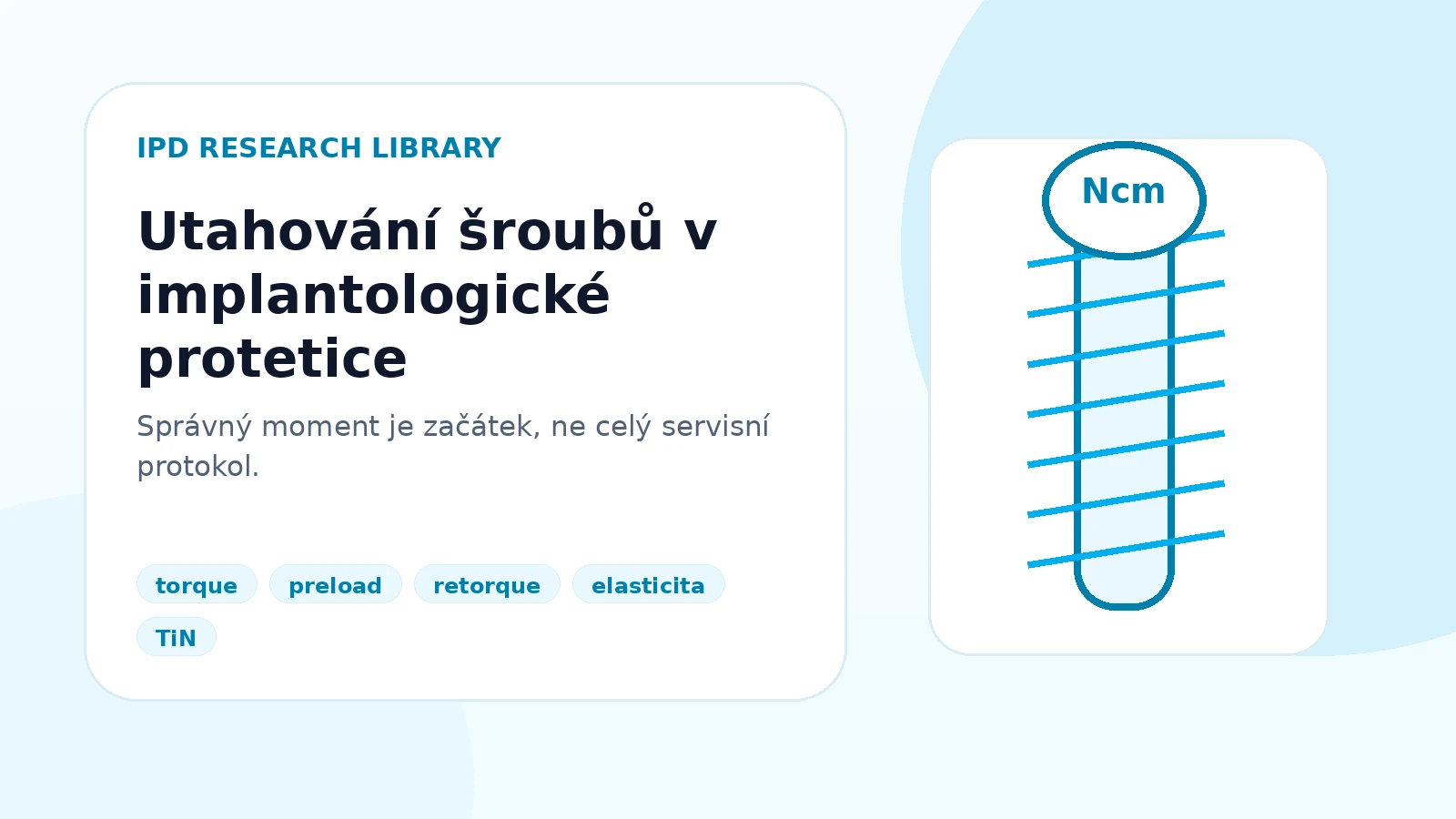
Tightening screws in implant prosthetics
Original title: A Comprehensive Guide to Screw Tightening Techniques
A practical article explaining why the Ncm value alone is not enough. The page covers preload, retightening, screw-loosening risk and the importance of the correct instrument.
Clinical workflow and digital accuracy
Articles focused on the route from scanning to design, the working model and the practical prosthetic outcome.
Full-arch scanClinical & technical article
Splinted scan bodies and full-arch digital-scan accuracy
Original title: Effect of splinting scan bodies on the trueness of complete-arch digital implant scans with 5 different intraoral scanners
This study is a useful foundation for the full-arch scanning section. It explains the importance of stable scan reference points, data consistency and control of deformation.
Scan-body libraryClinical & technical article
Scan-body shape, intraoral scanner and library matching
Original title: Influence of different scan body design features and intraoral scanners on the congruence between scan body meshes and library files
A scan body is not merely an object to scan, but reference geometry that must connect unambiguously to the CAD-software library.
In vitro scanbodyClinical & technical article
Effect of scan-body shape and size on scan accuracy
Original title: Effect of shape and size of implant scan body on scanning accuracy: An in vitro study
The detailed article explains how scan-body geometry affects data acquisition, scanner readability and subsequent CAD-design accuracy.
Study commentaryClinical & technical article
Scan body as reference geometry in the digital workflow
Original title: The Influence of Shape and Size of ScanBodies: An In Vitro Study on Accuracy and Precision
We treat this topic practically: what scan-body shape and size mean for component selection, scanning strategy and technical support.
Chairside workflowClinical & technical article
Implant restoration in a fully digital chairside workflow
Original title: Implant restoration through a full digital additive chairside workflow: a simple case
A case report well suited to a clear page on the continuity between scanning, CAD design, 3D printing and the final prosthetic restoration.
3D printingClinical & technical article
3D-print settings and mechanical properties of dental products
Original title: Impact of 3D Printing Configurations on the Physical and Mechanical Properties of Dental Products
This article belongs to the digital-analog and 3D-model cluster. It shows why calibration and print settings influence both accuracy and mechanical properties of the model.
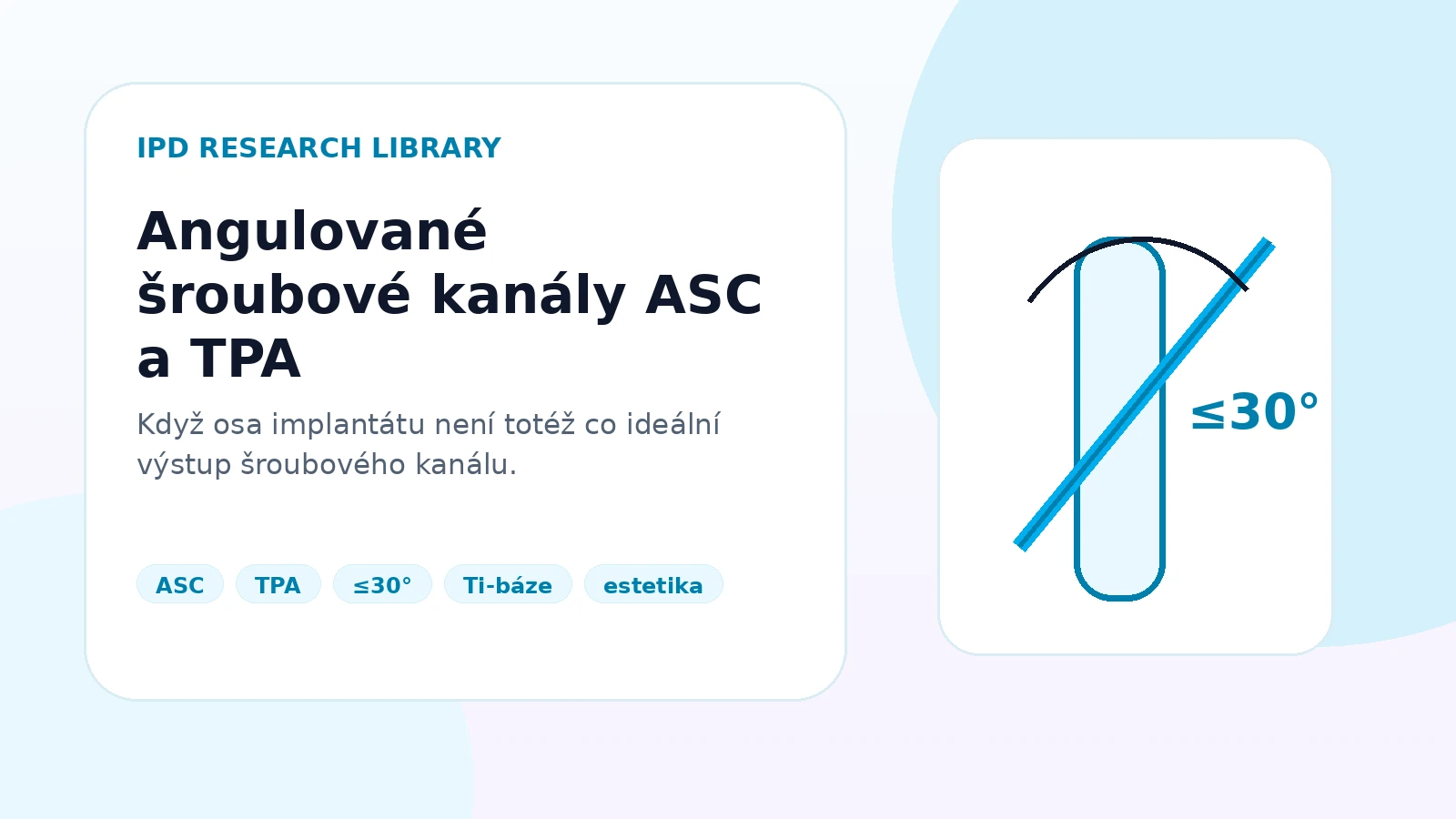
ASC / TPAClinical & technical article
ASC and TPA angulated screw channels
Original title: Advanced Esthetic and Functional Solutions in Implantology: The Revolution of ASC / TPA Inclined Screw Channels
The article explains why angulating the screw channel can preserve a screw-retained protocol where a straight channel would be aesthetically or functionally unsuitable.
Technical principles and biomechanics
Articles explaining screws, surfaces, stress, uncertainty and the mechanical behaviour of implant-prosthetic connections.
Accuracy cornerstoneClinical & technical article
The importance of accuracy in implant prosthetics
Original title: The Significance of Precision in Fabricating Implant-Supported Dental Prosthetics
A concise IPD white paper presents accuracy as the central axis of the implant-prosthetic chain, from planning through scanning and CAD design to final fit, occlusion and long-term behaviour of the restoration.
White paperClinical & technical article
Accuracy of CAD/CAM restorations and deviation control
Original title: The Significance of Precision in Fabricating Implant-Supported Dental Prosthetics
An extended document on the importance of accuracy in implant prosthetics. The detailed page treats it as a practical guide to where deviation enters the digital workflow and how it can be reduced.
Fixation screwsClinical & technical article
Tightening screws in implant prosthetics
Original title: A Comprehensive Guide to Screw Tightening Techniques
A practical article explaining why the Ncm value alone is not enough. The page covers preload, retightening, screw-loosening risk and the importance of the correct instrument.

Ti-base FEMClinical & technical article
Ti-base gingival height and biomechanics of two-piece abutments
Original title: Effect of gingival height of a titanium base on the biomechanical behavior of 2-piece custom implant abutments
The detailed page supports the Ti-base section and examines the relationship between titanium-base height, stress distribution and the behaviour of a two-piece abutment.

Screw looseningClinical & technical article
Implant contact surfaces and risk of screw loosening
Original title: Effects of the internal contact surfaces of dental implants on screw loosening
The study shows that screw-joint stability depends not only on tightening torque but also on contact geometry, load transfer and micromotion at the interface.

Hexalobular screwClinical & technical article
Effect of screwdriver angle on an off-axis system and hexalobular screw
Original title: The effect of screwdriver angle variation on the off-axis implant abutment system and hexalobular screw
A practical technical article for situations in which the instrument does not work coaxially with the screw. The topic connects directly to ASC/TPA and safe use of angulated screw channels.

FEM and vectorsClinical & technical article
Vector analysis and FEM in implant-prosthetic design
Original title: Vector Analysis and FEM to Design Prostheses on Implants?
The technical layer of the library that presents prosthetic design in terms of force direction, contacts, occlusion and areas of mechanical risk.

TiN surfaceyClinical & technical article
Nitrided and anodically oxidised titanium in contact with soft tissues
Original title: Nitride-Coated and Anodic-Oxidized Titanium Promote a Higher Fibroblast and Reduced Streptococcus gordonii Proliferation Compared to the Uncoated Titanium
Laboratory findings must not be converted into clinical promises. The article nevertheless supports discussion of soft tissues, the aesthetic gold tone and surface behaviour.
ZrN coatingClinical & technical article
Zirconium nitride coating on titanium abutments
Original title: Biocompatibility and antibacterial properties of zirconium nitride coating on titanium abutments
The page explains how biocompatibility and bacterial adhesion are assessed on surface-treated abutments.

Literature reviewClinical & technical article
TiN coating of implant abutments: from engineering to clinical use
Original title: Titanium Nitride Coated Implant Abutments: From Technical Aspects and Soft Tissue Biocompatibility to Clinical Applications
A review article bridging the technical properties of the coating, biocompatibility and practical implant prosthetics.
TiO₂* anataseClinical & technical article
TiO₂ anatase and titanium-surface properties
Original title: TiO2 Anatase: What You Should Know But It’s Not Always Explained
A technical explainer on titanium surfaces. The detailed page separates the material principle, laboratory observations and clinical relevance.
UncertaintyClinical & technical article
Reducing uncertainty in the digital dental workflow
Original title: Reducing Spheres of Uncertainty in the Digital Dental Flow
A conceptual article connecting scanning, libraries, CAD, 3D printing, milling, fit verification and service protocols as a chain for reducing uncertainty.
Decision makingClinical & technical article
Uncertainty in clinical decision-making and the role of protocol
Original title: Situating Uncertainty in Clinical Decision Making
A conceptual text explaining why the IPD website is built not only around products but also around protocols, verification and workflow standardisation.
Original source articles for download
Each detailed page contains an English editorial treatment together with a link to the original PDF, allowing readers to verify the original methods, wording and results.
| English working title | Category | Tempo | |
|---|---|---|---|
| The importance of accuracy in implant prosthetics The Significance of Precision in Fabricating Implant-Supported Dental Prosthetics | Technical principles and biomechanics | Clinical & technical article | Download PDF |
| Accuracy of CAD/CAM restorations and deviation control The Significance of Precision in Fabricating Implant-Supported Dental Prosthetics | Technical principles and biomechanics | Clinical & technical article | Download PDF |
| Splinted scan bodies and full-arch digital-scan accuracy Effect of splinting scan bodies on the trueness of complete-arch digital implant scans with 5 different intraoral scanners | Clinical workflow and digital accuracy | Clinical & technical article | Download PDF |
| Scan-body shape, intraoral scanner and library matching Influence of different scan body design features and intraoral scanners on the congruence between scan body meshes and library files | Clinical workflow and digital accuracy | Clinical & technical article | Download PDF |
| Tightening screws in implant prosthetics A Comprehensive Guide to Screw Tightening Techniques | Technical principles and biomechanics | Clinical & technical article | Download PDF |
| Effect of scan-body shape and size on scan accuracy Effect of shape and size of implant scan body on scanning accuracy: An in vitro study | Clinical workflow and digital accuracy | Clinical & technical article | Download PDF |
| Scan body as reference geometry in the digital workflow The Influence of Shape and Size of ScanBodies: An In Vitro Study on Accuracy and Precision | Clinical workflow and digital accuracy | Clinical & technical article | Download PDF |
| Implant restoration in a fully digital chairside workflow Implant restoration through a full digital additive chairside workflow: a simple case | Clinical workflow and digital accuracy | Clinical & technical article | Download PDF |
| 3D-print settings and mechanical properties of dental products Impact of 3D Printing Configurations on the Physical and Mechanical Properties of Dental Products | Clinical workflow and digital accuracy | Clinical & technical article | Download PDF |
| ASC and TPA angulated screw channels Advanced Esthetic and Functional Solutions in Implantology: The Revolution of ASC / TPA Inclined Screw Channels | Clinical workflow and digital accuracy | Clinical & technical article | Download PDF |
| Ti-base gingival height and biomechanics of two-piece abutments Effect of gingival height of a titanium base on the biomechanical behavior of 2-piece custom implant abutments | Technical principles and biomechanics | Clinical & technical article | Download PDF |
| Implant contact surfaces and risk of screw loosening Effects of the internal contact surfaces of dental implants on screw loosening | Technical principles and biomechanics | Clinical & technical article | Download PDF |
| Effect of screwdriver angle on an off-axis system and hexalobular screw The effect of screwdriver angle variation on the off-axis implant abutment system and hexalobular screw | Technical principles and biomechanics | Clinical & technical article | Download PDF |
| Vector analysis and FEM in implant-prosthetic design Vector Analysis and FEM to Design Prostheses on Implants? | Technical principles and biomechanics | Clinical & technical article | Download PDF |
| Nitrided and anodically oxidised titanium in contact with soft tissues Nitride-Coated and Anodic-Oxidized Titanium Promote a Higher Fibroblast and Reduced Streptococcus gordonii Proliferation Compared to the Uncoated Titanium | Technical principles and biomechanics | Clinical & technical article | Download PDF |
| Zirconium nitride coating on titanium abutments Biocompatibility and antibacterial properties of zirconium nitride coating on titanium abutments | Technical principles and biomechanics | Clinical & technical article | Download PDF |
| TiN coating of implant abutments: from engineering to clinical use Titanium Nitride Coated Implant Abutments: From Technical Aspects and Soft Tissue Biocompatibility to Clinical Applications | Technical principles and biomechanics | Clinical & technical article | Download PDF |
| TiO₂ anatase and titanium-surface properties TiO2 Anatase: What You Should Know But It’s Not Always Explained | Technical principles and biomechanics | Clinical & technical article | Download PDF |
| Reducing uncertainty in the digital dental workflow Reducing Spheres of Uncertainty in the Digital Dental Flow | Technical principles and biomechanics | Clinical & technical article | Download PDF |
| Uncertainty in clinical decision-making and the role of protocol Situating Uncertainty in Clinical Decision Making | Technical principles and biomechanics | Clinical & technical article | Download PDF |
Glossary of abbreviations and specialist terms
An asterisk next to a term in the text refers to its explanation below.
- post-curing
- Post-curing is the additional curing of a printed resin object after 3D printing.
- full-arch
- Full-arch means the entire dental arch, typically a scan or reconstruction of a complete edentulous arch.
- chairside
- Chairside describes a workflow performed directly in the clinic or immediately adjacent to the dental chair.
- preload
- Preload is the tensile force generated in a screw after tightening that keeps the joint clamped together.
- torque
- Torque is the tightening moment, the controlled rotational force applied when tightening a screw.
- trueness
- Trueness describes how close a measurement result is to the true reference value.
- accuracy
- Accuracy describes overall closeness to the true value.
- precision
- Precision describes repeatability, the ability to obtain similar results when a measurement is repeated.
- nesting
- Nesting is the arrangement of objects on the printing platform or within the manufacturing space.
- mesh
- A mesh is a 3D network of points and surfaces generated during digital scanning.
- ASC
- ASC means angulated screw channel, allowing screw access to be redirected away from the implant's straight axis.
- TPA
- TPA is IPD's solution for an angulated transocclusal fixation channel and screw tightening at an angle.
- FEM
- FEM means finite element method, a computational simulation of stress and deformation in a model.
- TiN
- TiN means titanium nitride, a hard gold-coloured coating used on selected prosthetic components.
- ZrN
- ZrN means zirconium nitride, a hard ceramic coating investigated for titanium abutments.
- TiO₂
- TiO₂ is titanium dioxide, the natural oxide layer associated with titanium-surface behaviour.
- IOS
- IOS means intraoral scanner, a scanner used directly inside the patient's mouth.
New from IPD USA
Three new practical articles on digital continuity
We did not translate the original US materials mechanically. We adapted them to a technical context, added related pages and separated practically useful principles from marketing language.
Digital workflowAccuracy from scan to final restorationWhere geometric continuity is created and where it can be lost.CAD librariesTECH and LITE as a geometric bridgeHow the library converts the scan body into the virtual implant position.3D printingVerifying digital-analog seatingResin, exposure, orientation, post-processing and repeatability.
New in Resources
From technical article to clinical case
A new branch of the library separates technical principles from case reports, making it clear whether the reader is looking at a general principle, a specific case or manufacturer documentation.
