Exclusive IPD distributor for the Czech and Slovak RepublicsOriginal components · CAD/CAM libraries · technical support+420 604 483 343obchod@exklusiv-dent.cz
Clinical education

Digital dentistry does not start with software. It starts with data continuity.

The article explains the digital workflow from the clinician’s perspective: a scan body is not an isolated “scanning part”, but a physical link connected to a corresponding library and prosthetic option.

Why a digital workflow makes sense

The authors describe the main benefits of digitalisation as accuracy, faster communication between clinic and laboratory and greater predictability. They also emphasise that a digital workflow does not replace knowledge of analogue principles, but translates them into a different environment.

Scan body + library + prosthetic solution

Every scan body must be linked to the corresponding digital library. The source text summarises the practical logic of a digital solution in three parts: SCANBODY + PROSTHETIC SOLUTION + DIGITAL ANALOGUE. This relationship is more useful than selecting a component in isolation by appearance or name.

Scan-body material and geometry

The source distinguishes between different scan-body designs and discusses the practical characteristics of a titanium-base/PEEK combination. For the local workflow, it is equally important that the selected geometry has the correct library branch and corresponding prosthetic components.

Key takeaway

Before starting the restoration, verify four things: implant platform, physical scan body, selected library and intended prosthetic component. Only when all four correspond does the digital chain become reliable.

Related topics

From the scan body to the physical prosthetic restoration

Ricardo Recena and Marta Arjona Vázquez present digital dentistry as a connected sequence of clinical and laboratory steps. We have added illustrations and practical checks to make the workflow clearer.

Digital dentistry · IPD

Transferring implant position

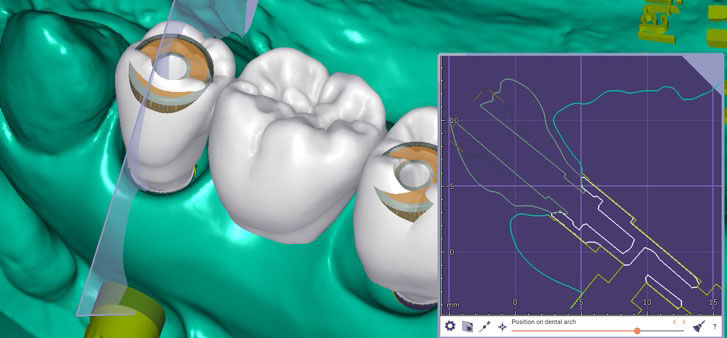
After intraoral acquisition, the CAD library must match the scan body’s known reference geometry to the correct position and orientation of the implant or abutment interface. A visually attractive mesh may still be misregistered when the wrong library is selected.

PEEK, titanium and hybrid scan bodies

The original source discusses different scan body materials and designs. Optical capture, mechanical seating, durability and compatible library versions all matter. No single material should be presented as universally best across scanners.

Choosing the restorative solution

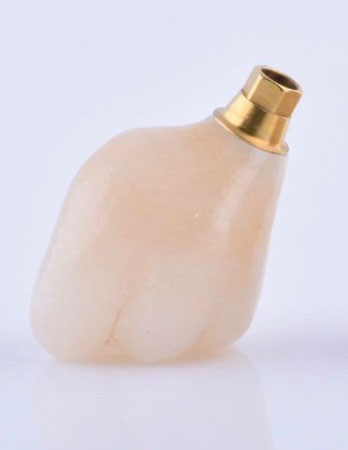
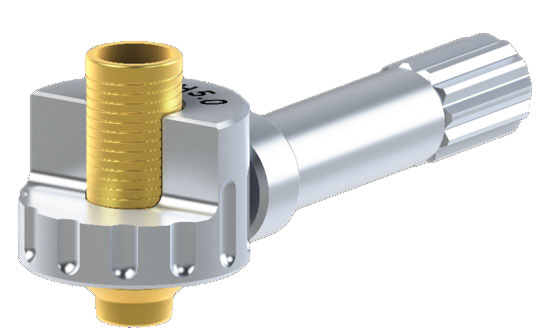
Ti-bases, adjustable bonding heights, angulated screw channels and digital analogues must be matched to the exact part reference, interface and library version. Similar-looking components should not be assumed interchangeable.

Digital analogue and printed model

The digital position must be carried over to the physical model. Check analogue seating and fixation together with printing parameters and model validation.

Biology and digital design

Transmucosal height and emergence profile are important, but no single abutment dimension guarantees healthy peri-implant tissue or long-term clinical success.

Illustrated examples

The source mentions manufacturing tolerances and biological observations. These should not be interpreted as a guarantee of total workflow accuracy or outcomes. IPD TECH/LITE is later context, not terminology from the original article.

Original source: Digital dentistry: discover its benefits and how libraries are used · Ricardo Recena, Marta Arjona Vázquez

CAD/CAM library selection →