English technical abstract
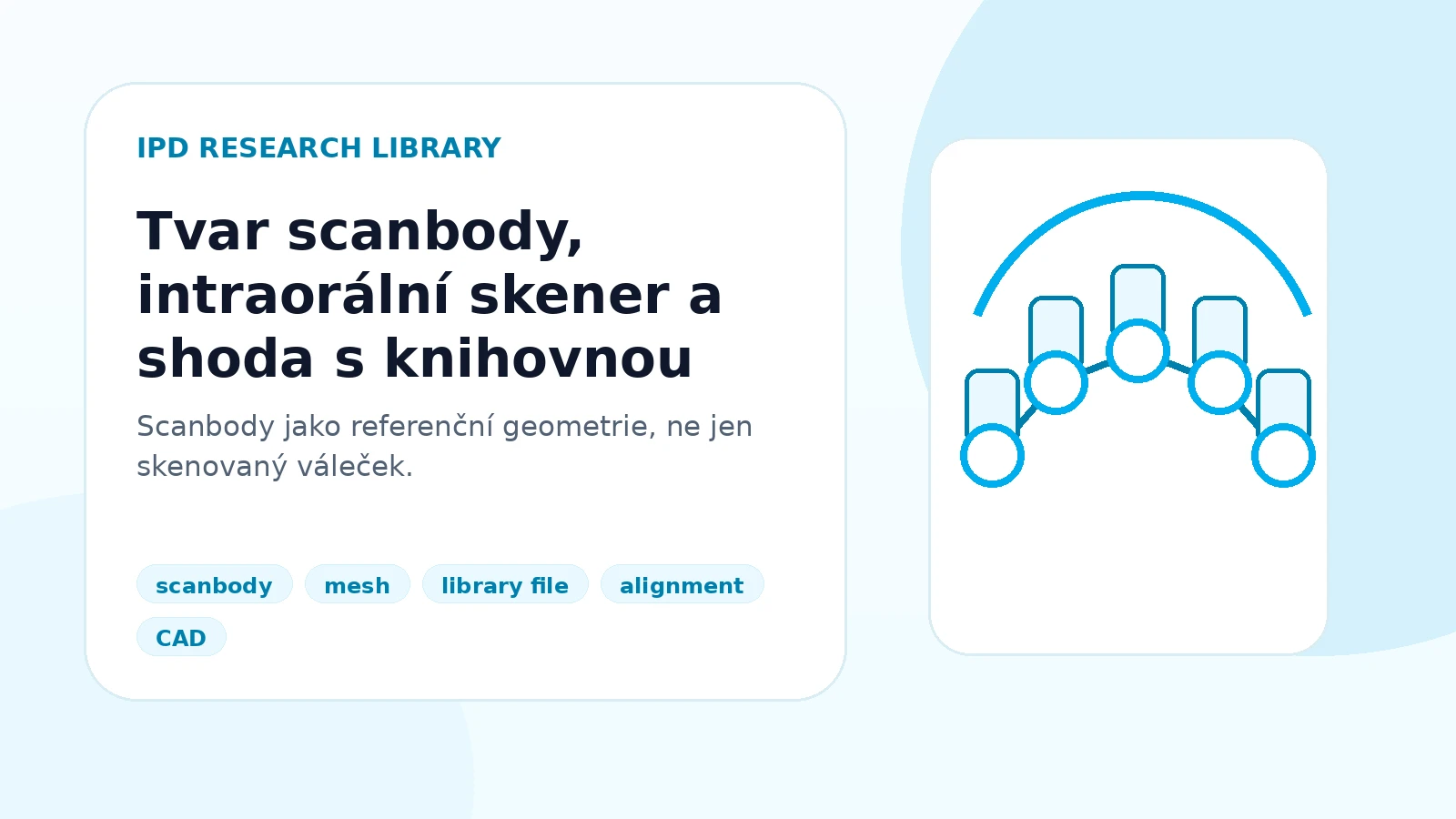
The study evaluated how different scan-body shapes and materials affect the match between the scan and the library file in CAD software. This match is critical in digital implant prosthodontics because the software uses the scan body not as an aesthetic object, but as reference geometry for implant position.
The results showed a significant interaction between scanner model and scan-body model. Simpler, less complex geometry with fewer sharp edges and a cylindrical shape demonstrated better congruence between the clinical mesh and library.
What the article covers and how to read it
Relevance for the laboratory, dental practice and technical support
- A good scan body must be clearly readable by the scanner and reliably matchable to the CAD library.
- When troubleshooting library matching or seating, it is useful to distinguish whether the problem arises in the scan, library matching, scan-body design or a subsequent manufacturing step.
- For technical support, this article provides a useful basis for explaining the difference between OEM/LITE and IPD/TECH workflows.
Limitations and cautious interpretation
Original source article
Original title: Influence of different scan body design features and intraoral scanners on the congruence between scan body meshes and library files
Download the original PDF
The source document remains available so that the original wording, methodology and results can be checked.
Related IPD pages and workflows
Glossary of abbreviations and specialist terms
An asterisk next to a term in the text refers to its explanation below.
- full-arch
- Full-arch means the entire dental arch, typically a scan or reconstruction of a complete edentulous arch.
- alignment
- Alignment is the registration or matching of a scanned 3D model to reference library geometry in CAD software.
- mesh
- A mesh is a 3D network of points and surfaces generated during digital scanning.
