
English technical abstract
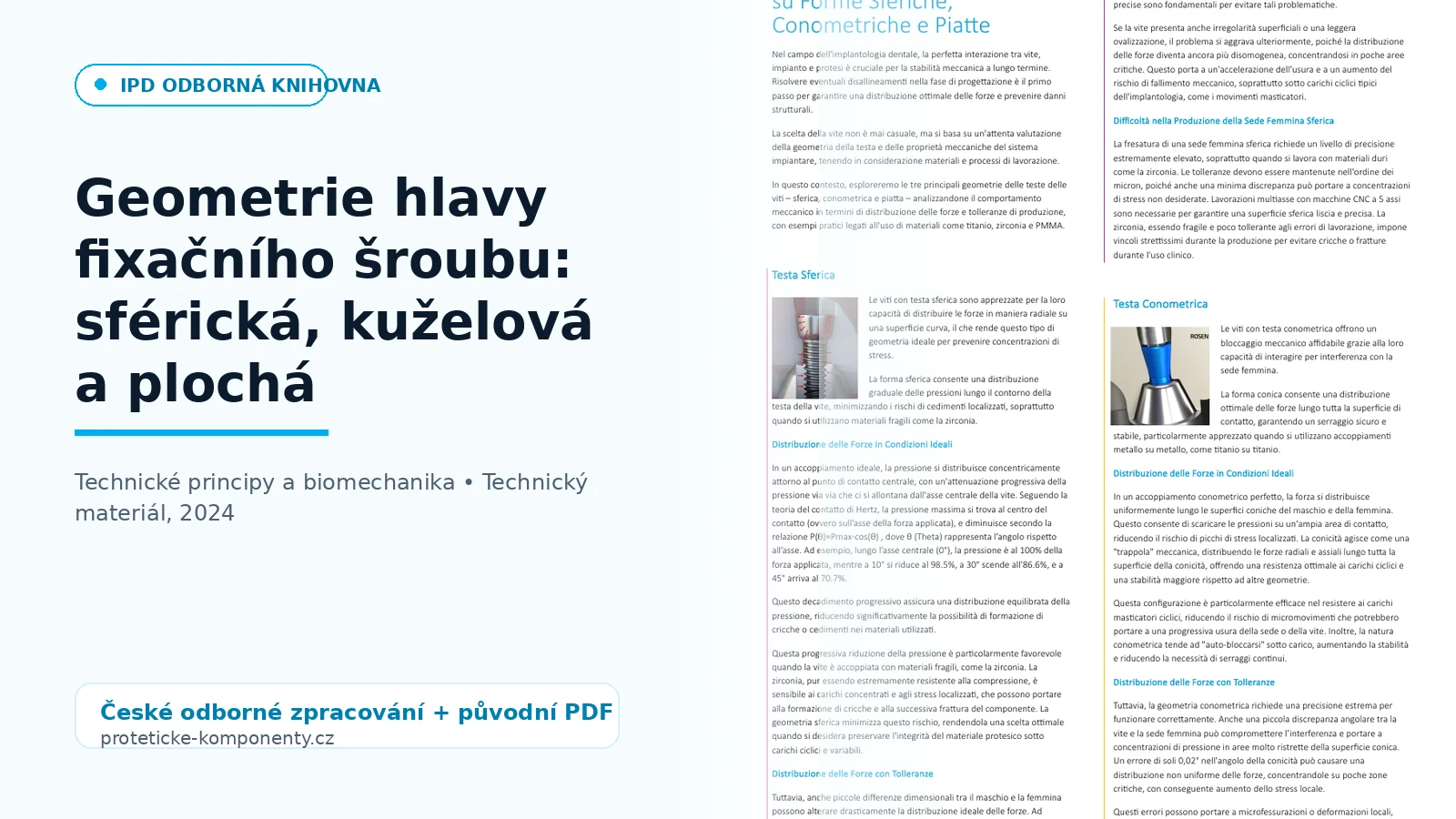
The technical text compares spherical, conical and flat seating geometries of the screw head. In an ideal model, each distributes force differently: spherical geometry radially, conical geometry along the conical surface and flat geometry across the plane. Clinical and manufacturing reality, however, never operates with zero tolerance.
A small deviation in diameter, angle or flatness can turn area contact into a narrow line or a few points. This is particularly important with brittle zirconia and more deformable PMMA. The article therefore highlights the Ti-base as a way of keeping the critical screw interface within an industrially manufactured metal-to-metal contact rather than transferring micron-level demands directly to milled ceramic or polymer.
What the article shows
Comparison of real behaviour under manufacturing tolerances
| Geometry | Ideal contact | Critical tolerance | Typical risk |
|---|---|---|---|
| Spherical | Radial distribution over a curved surface | Diameter and spherical match of both surfaces | Line contact and local pressure |
| Conical | Contact along the conical surface | Cone angle, coaxiality and surface | Contact over only part of the cone, micromovement or high local stress |
| Flat | Uniform distribution across a plane | Flatness and perpendicularity to the screw axis | Central or edge loading, levering |
What this means for the laboratory and clinic
- Always use the screw specified for the particular abutment or Ti-base; a similar thread does not mean an identical head and seating surface.
- When designing a custom abutment, do not mill the critical screw seat directly in zirconia or PMMA unless using a validated system.
- Check that the CAD library corresponds to the actual Ti-base geometry and that the design does not alter the prescribed seating area.
- Do not treat damage to the screw head, seat or instrument as a cosmetic defect because it changes force distribution and the preload achieved.
The article complements the IPD fixation-screw and Ti-base pages by explaining why the screw, Ti-base and screwdriver must be understood as one geometrically matched assembly and why individual parts cannot be substituted solely on the basis of thread size.
Limitations and cautious interpretation
Original source article
Original title: Testa delle Viti: Analisi Tecnica Approfondita su Forme Sferiche, Conometriche e Piatte
Authors and source: Technical article, author not stated in the source material; Technical material, 2024.
Download the original PDF
The original Italian document contains the complete text, image documentation and any bibliography included by the authors.
Related IPD pages and workflows
Glossary of technical terms
- seating surface
- The geometry through which the screw head transfers force into the abutment or restoration.
- coaxiality
- Alignment of the screw axis and the axis of its seat.
- tolerance
- Permitted manufacturing deviation in dimension, angle or shape.
- metal-to-metal contact
- A mechanical interface in which both contact surfaces are metal components.
