
English technical abstract
Titanium combines low density, high specific strength, corrosion resistance and biocompatibility. Yet the very properties that make it suitable for implant dentistry complicate machining. Heat generated at the cutting zone is poorly conducted into the workpiece, the material reacts chemically with the tool, and its low elastic modulus promotes vibration and elastic deflection.
The source article follows the pathway from crystalline phases and alloys to surface integrity, tool wear and fatigue cracking. The practical message is clear: running a four- or five-axis milling machine is not the same as mastering titanium machining. Strategy, tool geometry, cooling, workholding and surface inspection together determine the service life of the finished component.
What the article shows
From alloy to long-term service life: five linked checks
Verified alloy, blank condition and suitability for the medical device.
Cutting speed, feed, depth of cut and toolpath are appropriate for titanium.
Effective cooling and lubrication limit overheating of the cutting edge and surface layer.
Inspect for burrs, tool marks, overheating and microdamage.
Minimise stress raisers, design cross-sections appropriately and account for predictable cyclic loading.
Subsurface damage and residual stresses may remain hidden while still influencing fatigue-crack initiation.
What this means for the laboratory and clinic
- Use CAM strategies and tools intended for titanium rather than generic parameters transferred from another metal.
- Treat coolant condition, flow, temperature and system cleanliness as manufacturing parameters, not merely maintenance details.
- For premills and customised abutments, protect the industrially manufactured implant interface from secondary damage.
- After machining, assess not only dimensions but also the surface, sharp transitions, tool marks and stress-concentration areas.
The article adds the material-science “why” to the premill and Ti-base product pages. It also creates a natural link to TiN surfaces and fixation screws: long-term performance does not begin with coating or tightening, but with alloy selection and the integrity of the machined surface.
Limitations and cautious interpretation
Original source article
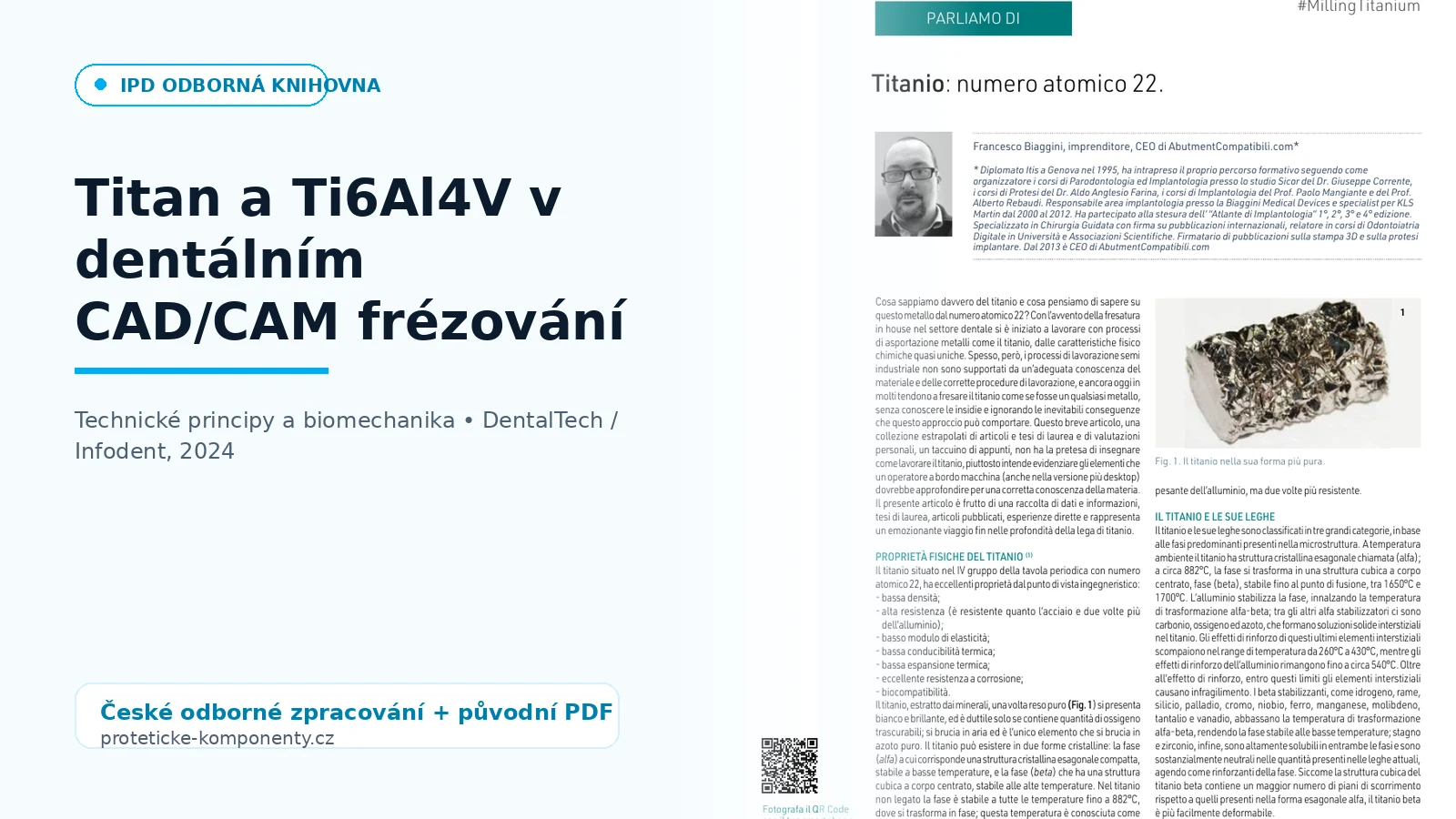
Original title: Titanio: numero atomico 22
Authors and source: Francesco Biaggini; DentalTech / Infodent, 2024.
Download the original PDF
The original Italian document contains the complete text, image documentation and any bibliography included by the authors.
Related IPD pages and workflows
Glossary of technical terms
- Ti6Al4V
- Titanium alloy containing approximately 6% aluminium and 4% vanadium, commonly referred to as Grade 5.
- surface integrity
- The combined geometric, metallurgical and stress-related properties of the surface and subsurface layer.
- built-up edge
- Workpiece material adhering to the cutting tool, altering cutting geometry and quality.
- fatigue crack
- A crack that initiates and propagates under repeated cyclic loading.
