

English technical abstract
The source combines a clinical case, a methodological text on “spheres of uncertainty” and an interview about quality in digital prosthodontics. The common denominator is a rejection of the shortcut assumption that an expensive scanner or a smooth CAD design automatically means an accurate result.
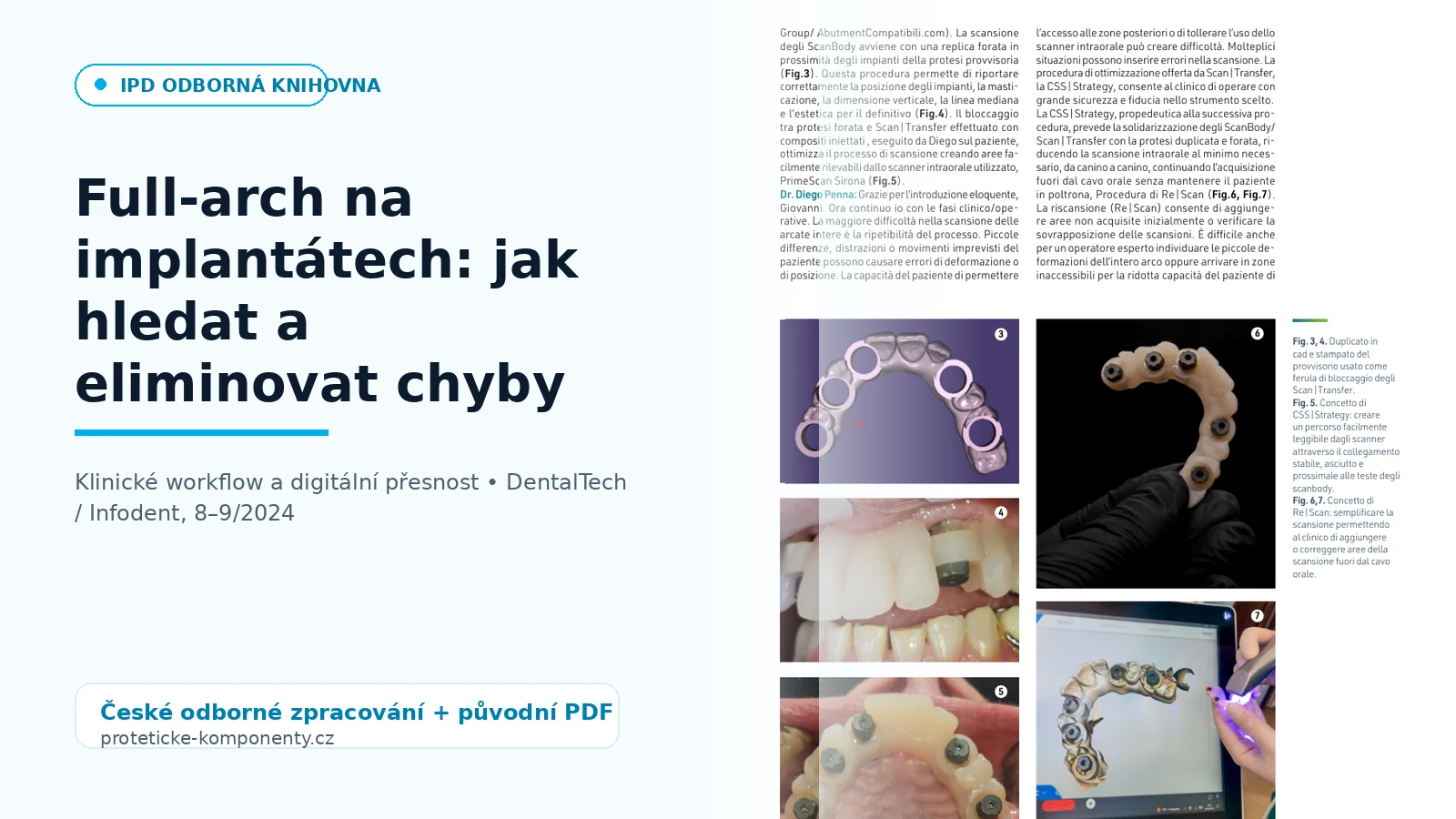
The described protocol uses the provisional restoration as the carrier of verified aesthetics, occlusion and vertical dimension. Implant positions are recorded with rigidly connected ScanTransfers. CSS Strategy stabilises the scan, ReScan allows a problematic section to be corrected, and DeBug uses a physical verification key or master. Digital and analogue verification are not competitors here, but two independent layers of the same safety system.
What the article shows
Error behaves like dominoes. The protocol must stop it between steps.
Incorrect scan path, loss of orientation, difficult distal segments or unstable references.
Incorrect data stitching, uncritical acceptance of the mesh and a design built on an erroneous position.
Milling, printing, Ti-base bonding and material flexibility can conceal or magnify an error.
Without independent validation, the problem may become apparent only through passive fit, screw complications or long-term loading.
What this means for the laboratory and clinic
- Carry forward all information already verified in the functional provisional restoration rather than starting the definitive design from zero.
- When scanning multiple implants, create stable, easily readable reference geometry.
- Before manufacturing, define how CAD-data accuracy will be verified and how Ti-base bonding will be checked.
- Do not treat a soft or flexible material as proof of passive fit merely because it can be made to “seat somehow” on the model or implants.
For the IPD website, this is a backbone article linking ScanLogiQ, Scan Transfer for MUA, digital analogs and Ti-bases. It shows that the components make sense as one controlled chain, not as isolated order items.
Limitations and cautious interpretation
Original source article
Original title: La full arch su impianti: come eliminare gli errori?
Authors and source: Diego Penna, Giovanni Rossi, Francesco Biaggini; technical introduction by Francesco Mangano; DentalTech / Infodent, 8–9/2024.
Download the original PDF
The original Italian document contains the complete text, image documentation and any bibliography included by the authors.
Related IPD pages and workflows
Glossary of technical terms
- CSS Strategy
- Continuous Scan Strategy, a standardised procedure for continuous and stable acquisition.
- ReScan
- A procedure in which a problematic section of the record is supplemented or replaced with a new acquisition.
- DeBug
- Independent validation of data and the manufactured product, analogous to troubleshooting in a technical process.
- cross-mounting
- Transfer of verified relationships between the provisional restoration, scans and definitive restoration.
