
Exclusive IPD distributor for the Czech and Slovak RepublicsOriginal components · CAD/CAM libraries · technical support+420 604 483 343obchod@exklusiv-dent.cz
Inside ScanLogiQ · live in Žďár
Full-arch scan accuracy

Multidimensional errors in intraoral scanning

A scan body can be captured accurately at the local level while the complete arch already contains stitching errors, torsion and accumulated deviation. This article explains why both local detail and the global geometry of the scan must be verified.

Clinical workflow and digital accuracyNew Italian editionEnglish technical adaptation
Source authors: Francesco Plito, Nicola PalladinoPublication: CAD/CAM, 2/2023
Multidimensional errors in intraoral scanning
Multidimensional errors in intraoral scanning.

English technical abstract

A digital scan is not a single homogeneous measurement. The source article distinguishes error in the immediate vicinity of a scan body from deformation of the complete scanned arch. A scanner may capture a small object correctly while a long scan path, repeated loss of tracking and stitching of partial acquisitions introduce global displacement or torsion.

The authors therefore replace simple trust in the on-screen image with a system of verification gates. CSS Strategy is intended to simplify and stabilise acquisition, ReScan can replace a difficult section of the scan with a more accurate extraoral record, and DeBug reintroduces an independent physical check into the digital workflow. The practical goal is a passively fitting restoration, not merely a visually smooth mesh.

intraoral scanningfull-archmeshvalidationScanTransfer
Editorial note: This page is an English technical adaptation and practical interpretation of the original Italian source, not a literal translation. The original PDF is attached below for verification of the methodology, wording and image documentation.

What the article shows

Local accuracyCorrectly captured scan-body geometry does not by itself confirm the correct relative positions of all implants.
Global deformationAcross a long edentulous span, stitching, rotational and torsional errors can accumulate throughout the arch.
Operator and environmentAccess, mouth opening, saliva, surface characteristics and operator experience all affect acquisition stability.
Independent validationA physical master or extraoral verification should reveal deviation before it is transferred to the definitive restoration.

Four layers where error can hide

01AcquisitionScanner optics, surface characteristics, access and scan-path management.
02Stitching meshSoftware stitches partial acquisitions together. Each new stitch can introduce a small deviation.
03Full archLocal errors can appear as changes in distance or rotation between widely separated implants.
04Manufactured restorationCAD and manufacturing can carry forward, mask or further magnify an error. This is why an independent check is required.
A smooth 3D model is not automatically an accurate model.

The article’s central practical question is simple: how was the correctness of the data verified independently of the scanning software itself?

What this means for the laboratory and clinic

  • In a full-arch scan, assess not only the surface quality of individual scan bodies but also the relative distances and orientation of the complete assembly.
  • Minimise scan interruptions and long jumps between areas lacking clearly readable geometry.
  • For complex cases, use rigidly linked references and a verification protocol independent of the original acquisition.
  • Before definitive milling, verify the passive fit of the restoration or validation element on a physical master.
How this connects with IPD content

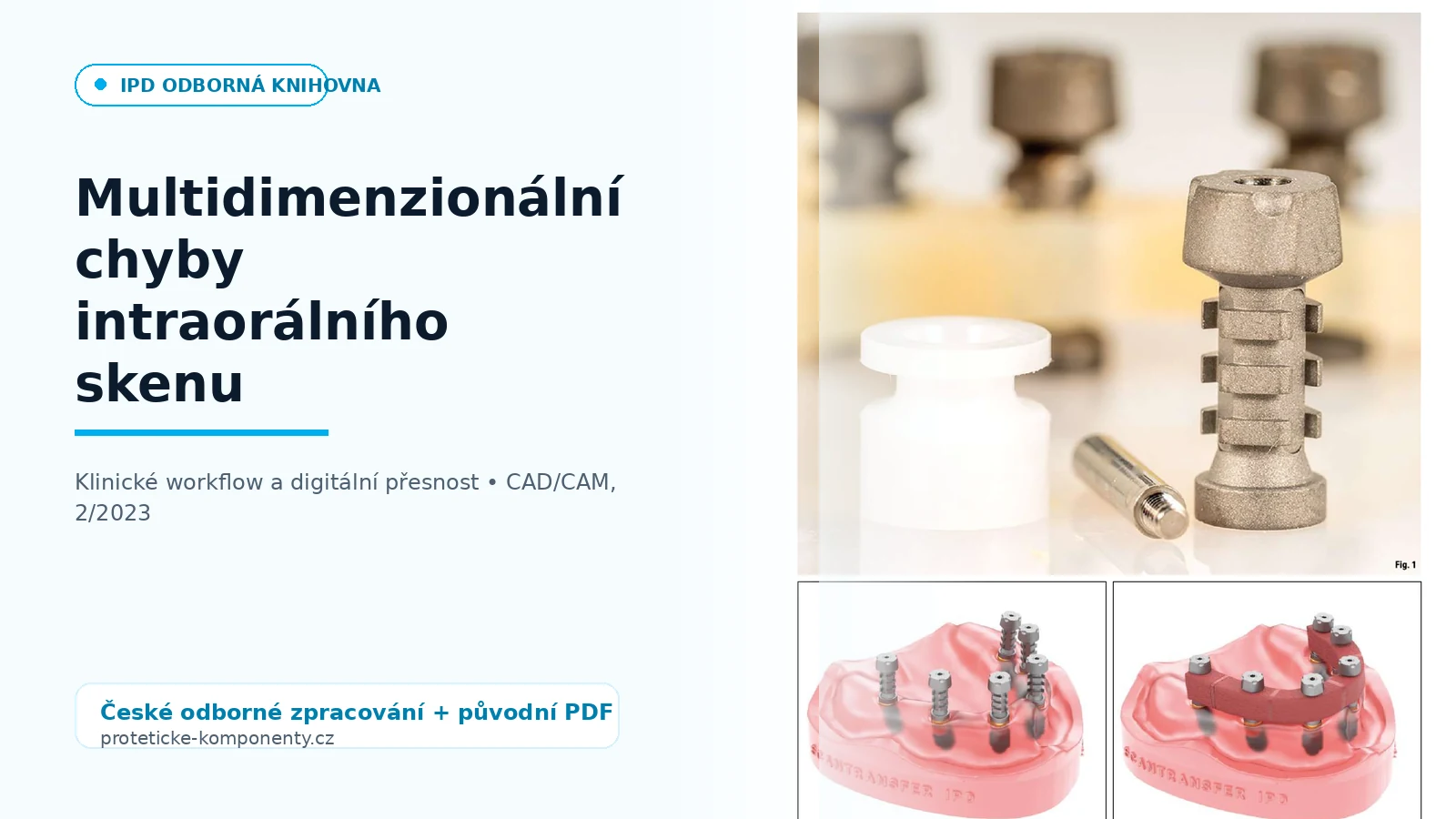
The article naturally explains the role of Scan Transfer and IPD full-arch protocols. Here the product is not “just another scan body”, but a tool for stabilising the scan path, transferring implant positions and creating a physical verification point.

Limitations and cautious interpretation

This is a professional industry report and case-based description of a specific workflow, not a randomised clinical study. The protocols should therefore be read as a risk-management system that must be validated for the specific combination of scanner, software, library and manufacturing process.

Original source article

Original title: Multi-dimensionalità degli errori nelle scansioni intraorali: possiamo finalmente affermare di avere i protocolli di validazione e verifica delle nostre acquisizioni intraorali?

Authors and source: Francesco Plito, Nicola Palladino; CAD/CAM, 2/2023.

Download the original PDF

The original Italian document contains the complete text, image documentation and any bibliography included by the authors.

PDF

Related IPD pages and workflows

Glossary of technical terms

stitching
Stitching partial images or 3D fragments into one continuous mesh.
mesh
A network of points and triangular surfaces describing the scanned 3D surface.
passive fit
A condition in which a restoration seats without forced flexure or unwanted preload.
full-arch
Acquisition or reconstruction of the complete dental arch.
e-dent logo

I am a healthcare professional within the meaning of Section 2a of Czech Act No. 40/1995 Coll., on the Regulation of Advertising. I confirm that I am authorised to access pages intended for healthcare professionals.