
English technical abstract
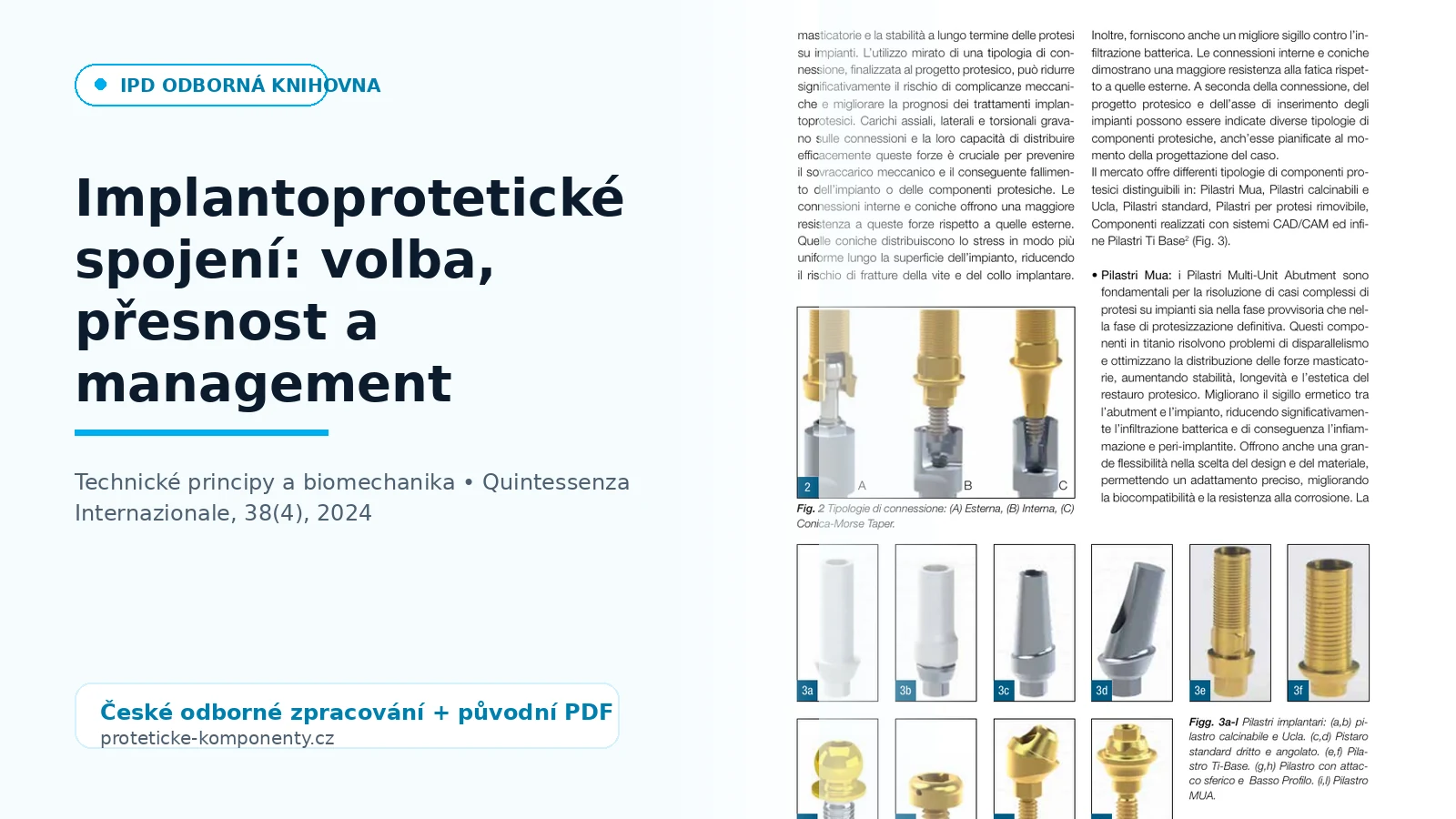
The implant–abutment connection is both a mechanical and a biological junction within the restoration. The source article compares external, internal and conical connections and emphasises that their suitability cannot be separated from restoration type, load direction, implant parallelism, framework material and manufacturing accuracy.
The article also maps prefabricated and customised components, including MUA, UCLA, standard abutments, attachments, CAD/CAM abutments and Ti-bases. Its strength lies in linking biomechanics with the manufacturing workflow and custom-made medical-device documentation. Component selection is not an isolated catalogue decision, but part of the project from implant to long-term service.
What the article shows
Decision matrix: connection, component, manufacturing and service
Connection type
Implant geometry determines anti-rotation, contact area, screw space and how axial and lateral forces are transferred.
Prosthetic indication
A single crown, bridge, full-arch restoration, removable prosthesis or non-parallel implants require different component strategies.
Material and manufacturing
Titanium, Co-Cr, zirconia, PMMA and hybrid assemblies differ in stiffness, interface accuracy and finishing requirements.
Documentation and service
Traceability of materials, libraries and components is part of a safe product and facilitates future servicing.
| Decision layer | What to verify | Risk if mismatched |
|---|---|---|
| Connection | Platform, indexing, seating surface, taper | Micromovement, microleakage, screw overload |
| Abutment | Height, angulation, retention, material, manufacturing tolerance | Insufficient stability or an unsuitable screw-channel exit |
| Screw | Correct type, torque, driver and permitted number of uses | Loss of preload, head damage, loosening |
| Restoration | Passive fit, occlusion, cleanability and serviceability | Fatigue damage, biological complication, difficult repair |
What this means for the laboratory and clinic
- Start by identifying the exact implant platform, then select the component and library.
- Do not automatically apply the same component strategy to single crowns, bridges and full-arch restorations.
- For customised CAD/CAM solutions, protect the industrially manufactured implant–abutment interface and verify screw compatibility.
- Record component, material and software-library identification, together with the final tightening protocol, in the manufacturing documentation.
This page creates a technical bridge between IPD Ti-bases, Multi-Unit abutments, fixation screws and MDR documentation. From one topic, the user can move directly to the correct component, library and service procedure without fragmenting the information into isolated catalogue sections.
Limitations and cautious interpretation
Original source article
Original title: Considerazioni, trattamento e gestione delle connessioni implanto-protesiche
Authors and source: Nicolino Angeloni, Damiano Cigni, Maria Sofia Rini; Quintessenza Internazionale, 38(4), 2024.
Download the original PDF
The original Italian document contains the complete text, image documentation and any bibliography included by the authors.
Related IPD pages and workflows
Glossary of technical terms
- implant–abutment interface
- Interface between the implant and prosthetic component.
- Morse taper
- Conical connection using close contact between tapered surfaces.
- preload
- Preload generated by tightening the screw.
- traceability
- Traceability of the components, materials and manufacturing steps used.
