

Digital scan
The original scan body and correctly selected library transfer the implant position into the CAD environment.
A digital solution for implant-supported crowns connecting a compatible CEREC® library, block geometry, precisely optimised Ti-base and a TiN-coated screw.
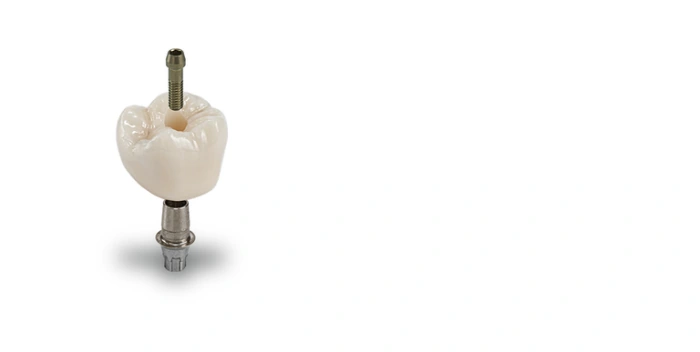
The IPD presentation describes five sequential steps: digital acquisition, CAD design, manufacture of the ceramic restoration, finishing and extraoral cementation onto the Ti-base, followed by intraoral fixation.
The original scan body and correctly selected library transfer the implant position into the CAD environment.
In CEREC® or inLab®, the correct library geometry is assigned and the implant crown is designed.
The ceramic block is milled to the designed shape. The material and block must match the selected library.
After sintering or crystallisation and glazing, the restoration is cemented extraorally onto the Ti-base.
The completed hybrid crown is secured to the implant using the torque specified for the system.
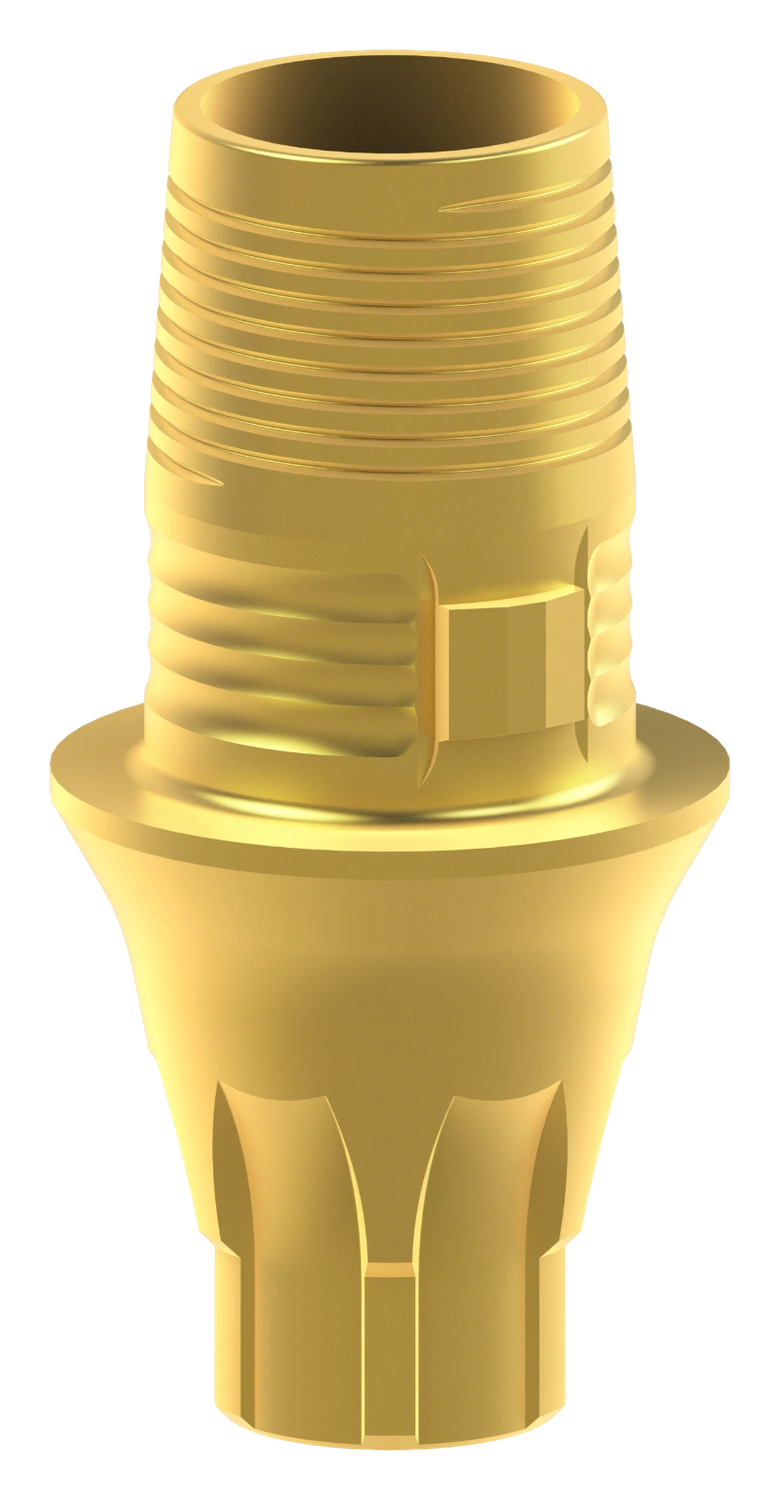
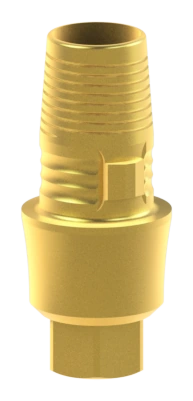
IPD states that the geometry and parameters are optimised for the original workflow. The design combines spiral grooves for mechanical retention of the cemented restoration, locking geometry for scan-body orientation and anti-rotation, and multiple gingival heights depending on the implant connection.
They increase the functional surface area and improve mechanical anchorage of the cemented ceramic restoration.
Helps provide unambiguous orientation of the scan body and implant-supported crown.
For most ranges 0.5 / 1.5 / 2.5 mm; for selected connections 0.8 mm or 1 / 2 / 3 mm.




The complete conversion table is reproduced directly in HTML. It can be searched by manufacturer, platform, IPD reference or CEREC® library.
| Range | Implant system | Implant platform | Ø prosthetic base | Gingival heights | Ti-base references | TiN screw | Torque | CEREC® library | Blok |
|---|---|---|---|---|---|---|---|---|---|
| AA | Nobel Biocare® Brånemark System® | Ø3.5 | Ø4.4 | 0.5 / 1.5 / 2.5 | IPD/AA-IN-00/SI · 02/SI · 04/SI | IPD/AA-TN-00/TIN | 35 Ncm | NB B 3.4 | L |
| AA | Nobel Biocare® Brånemark System® | Ø4.1 | Ø5.0 | 0.5 / 1.5 / 2.5 | IPD/AA-IR-00/SI · 02/SI · 04/SI | IPD/AA-TR-00/TIN | 35 Ncm | NB B 4.1 | L |
| AD | Nobel Biocare® Nobel Active® / Replace® Conical | NP Ø3.5 | Ø3.85 | 0.5 / 1.5 / 2.5 | IPD/AD-IN-00/SI · 02/SI · 04/SI | IPD/AA-TN-00/TIN | 35 Ncm | B C 3.4 | S |
| AD | Nobel Biocare® Nobel Active® / Replace® Conical | RP Ø4.3 | Ø5.0 | 0.5 / 1.5 / 2.5 | IPD/AD-IR-00/SI · 02/SI · 04/SI | IPD/AA-TR-00/TIN | 35 Ncm | NB B 4.1 | L |
| BB | Biomet 3i® Certain® | NP Ø3.4 | Ø3.85 | 0.5 / 1.5 | IPD/BB-IN-00/SI · 02/SI | IPD/BB-TR-01/TIN | 20 Ncm | B C 3.4 | S |
| BB | Biomet 3i® Certain® | RP Ø4.1 | Ø4.65 | 0.5 / 1.5 | IPD/BB-IR-00/SI · 02/SI | IPD/BB-TR-01/TIN | 20 Ncm | B C 4.1 | L |
| DA | Straumann® Tissue Level® | RN Ø4.8 | Ø5.0 | 0.8 | IPD/DA-IR-00/SI | IPD/DA-TR-01/TIN | 35 Ncm | S SO 4.8 | L |
| DB | Straumann® Bone Level® | NC Ø3.3 | Ø4.45 | 1 / 2 / 3 | IPD/DB-IN-00/SI · 02/SI · 04/SI | IPD/DB-TR-00/TIN | 35 Ncm | S BL 3.3 | L |
| DB | Straumann® Bone Level® | RC Ø4.1 | Ø4.55 | 1 / 2 / 3 | IPD/DB-IR-00/SI · 02/SI · 04/SI | IPD/DB-TR-00/TIN | 35 Ncm | S BL 4.1 | L |
| EA | Astra® Osseospeed TX™ | Ø3.5–Ø4.0 | Ø4.25 | 1 / 2 / 3 | IPD/EA-IR-00/SI · 02/SI · 04/SI | IPD/EA-TR-02/TIN | 20 Ncm | FX 3.8 | S |
| EB | Astra® Evolution® | S Ø3.6 | Ø3.85 | 0.5 / 1.5 / 2.5 | IPD/EB-IN-00/SI · 02/SI · 04/SI | IPD/EB-TN-00/TIN | 20 Ncm | B C 3.4 | S |
| EB | Astra® Evolution® | M Ø4.2 | Ø4.65 | 0.5 / 1.5 / 2.5 | IPD/EB-IR-00/SI · 02/SI · 04/SI | IPD/EB-TR-00/TIN | 20 Ncm | B C 4.1 | L |
| FA | Zimmer® Screw Vent® | Ø3.5 | Ø3.85 | 0.5 / 1.5 / 2.5 | IPD/FA-IN-00/SI · 02/SI · 04/SI | IPD/FA-TR-00/TIN | 30 Ncm | B C 3.4 | S |
| FA | Zimmer® Screw Vent® | Ø4.5 | Ø5.0 | 0.5 / 1.5 / 2.5 | IPD/FA-IR-00/SI · 02/SI · 04/SI | IPD/FA-TR-00/TIN | 30 Ncm | NB B 4.1 | L |
| LB | BioHorizons® Tapered Internal | Ø3.0 | Ø3.85 | 0.5 / 1.5 / 2.5 | IPD/LB-IT-00/SI · 02/SI · 04/SI | IPD/LB-TR-01/TIN | 35 Ncm | B C 3.4 | S |
| LB | BioHorizons® Tapered Internal | Ø3.5 | Ø3.85 | 0.5 / 1.5 / 2.5 | IPD/LB-IN-00/SI · 02/SI · 04/SI | IPD/LB-TR-01/TIN | 35 Ncm | B C 3.4 | S |
| LB | BioHorizons® Tapered Internal | Ø4.5 | Ø5.0 | 0.5 / 1.5 / 2.5 | IPD/LB-IR-00/SI · 02/SI · 04/SI | IPD/LB-TR-00/TIN | 35 Ncm | NB B 4.1 | L |
| TB | MIS® C1 / V3® | Standard | Ø5.11 | 0.5 / 1.5 / 2.5 | IPD/TB-IR-00/SI · 02/SI · 04/SI | IPD/TB-TR-00/TIN | 30 Ncm | NB B 4.1 | L |
Source: IPD CEREC® Ti-Base Conversion Guide 2024 and IPD product materials. For the Biomet 3i® Certain® range, the HTML references are standardised by platform as BB-IN for NP and BB-IR for RP. Always verify current availability, recommended torque and final compatibility in the valid instructions for use or with technical support.
The Conversion Guide provides an indicative relationship between the patient’s gingival height and the recommended Ti-base height. It is a guide, not a substitute for clinical assessment, material space or the rules of the specific implant system.

The IPD presentation emphasises the aesthetic benefit of TiN and antibacterial surface properties. Below, we distinguish between what laboratory studies show and what cannot automatically be extrapolated to the specific clinical product.
An in-vitro comparison of untreated Ti6Al4V, anodised surfaces, TiN and ZrN confirmed compatibility with gingival fibroblasts. ZrN showed the highest antibacterial activity; TiN also inactivated biofilm, but less markedly.
PLOS ONE · DOIA laboratory study reported greater gingival-fibroblast proliferation and lower Streptococcus gordonii growth on nitrided and anodised titanium than on untreated titanium.
Prosthesis · DOIA review summarises the technical and clinical context of TiN coatings on implant abutments, including aesthetics and a possible reduction in early bacterial colonisation.
PubMedImportant: The cited studies are not direct clinical trials of the specific IPD CEREC® Ti-base. Some results are in vitro, and Brunello et al. also compares TiN with ZrN. The website therefore does not attribute a therapeutic effect to the product and uses a factual description of the surface and available laboratory evidence.
The key is to maintain consistency between the implant platform, Ti-base, screw, gingival height, library and block geometry.
After digital scanning, the corresponding library and block are selected in the CAD environment, the crown is designed and milled, the ceramic is finished, the restoration is cemented extraorally onto the Ti-base and the completed crown is fixed intraorally.
No special clinical preparation of the product is stated in the presentation. However, knowledge of the CAD/CAM workflow, correct scanning equipment, a compatible library and a validated cementation protocol are essential.
According to the supplied presentation, the range is intended for implant-supported single crowns. Non-engaging variants were described as under development at the time of the source material; current status must be verified.
Find the manufacturer and implant platform in the conversion table, then check the IPD reference, screw, torque, CEREC® library and block size. Similar component shape is not sufficient evidence of compatibility.
The grooves increase the retentive geometry of the coronal part of the Ti-base and support mechanical anchorage of the cemented ceramic restoration.
Send us the implant brand, system, platform and planned gingival height. We will verify the matching Ti-base, fixation screw, torque and library geometry.
CEREC®, inLab® and Sirona® are trademarks of their respective owners. They are mentioned solely to identify compatibility. IPD and Exklusiv Dent s.r.o. do not own these trademarks. Use the product according to the current instructions for use and validated working procedures.

I am a dental professional within the meaning of Section 2a of Czech Act No. 40/1995 Coll., on advertising regulation. I confirm that I am authorised to access content intended for professionals.