
English technical abstract
The article begins with the prosthetic project rather than the implant itself. In an edentulous patient, a verified provisional restoration is the reference for vertical dimension, tooth position and occlusion. The digital impression for the definitive prosthesis should preserve this information and combine it with accurate implant positions and soft-tissue morphology.
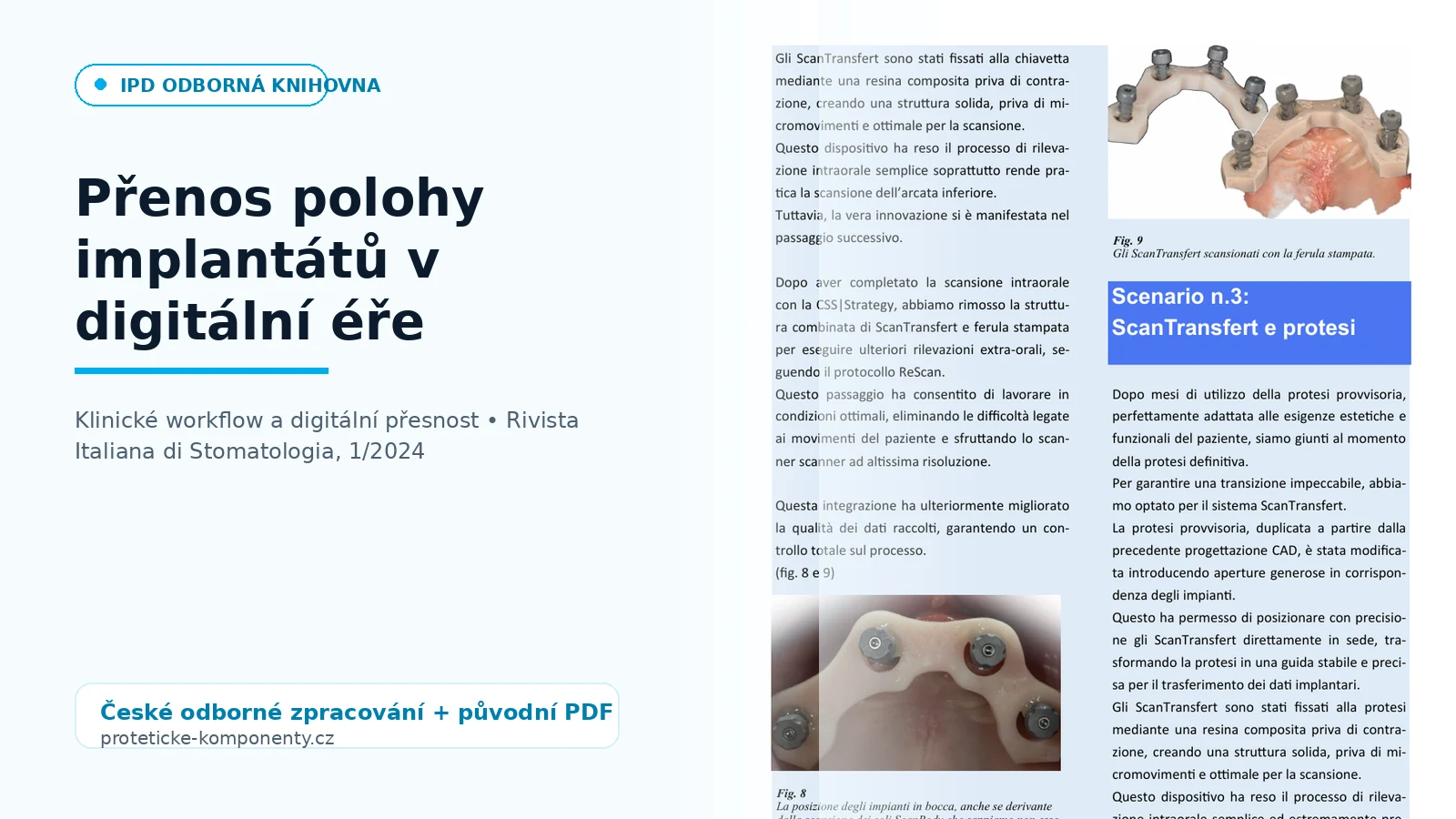
The authors compare three scenarios. Scan bodies alone are used as a basic record that must be verified with a prototype. Rigidly splinted Scan Transfers in a printed jig simplify scanning and support both ReScan and a physical master. The third option uses a modified provisional restoration as the impression and transfer carrier, allowing the laboratory to receive implant positions, teeth, occlusion and soft tissues in a single workflow.
What the article shows
What the laboratory needs to receive to avoid reconstructing clinical reality from incomplete data
3D position, axis, platform and spatial relationships.
Emergence, tissue-support area and available prosthetic space.
Verified provisional setup, midline, tooth length and lip support.
Intermaxillary relationship and functional contacts.
A physical reference or prototype that verifies implant positions.
Its value is not merely file registration, but preservation of verified relationships from the provisional restoration into the definitive prosthesis.
What this means for the laboratory and clinic
- Before the first definitive scan, define which information has already been clinically verified and must be preserved.
- Name the scans clearly and deliver them as one logical package, including occlusion and an extraoral record of the provisional restoration.
- Do not treat scan bodies alone as definitive proof of accuracy in a full-arch case without a prototype or independent validation.
- Use a rigid transfer or the provisional restoration as a common reference object linking multiple datasets.
This page connects Scan Transfer, digital analogs and ScanLogiQ in one practical scenario. From the article, the user can move to the appropriate product for a specific task: capture implant positions, create a verification model, or deliver a complete data package to the laboratory.
Limitations and cautious interpretation
Original source article
Original title: Il trasferimento della posizione implantare nell’era digitale: riflessioni e tecniche a confronto
Authors and source: R. Scrascia, N. Palladino; Rivista Italiana di Stomatologia, 1/2024.
Download the original PDF
The original Italian document contains the complete text, image documentation and any bibliography included by the authors.
Related IPD pages and workflows
Glossary of technical terms
- cross-mounting
- Transfer and registration of verified tooth position, occlusion and other relationships between the provisional restoration and definitive design.
- scan transfer
- Scanning and transfer component intended for rigid splinting of multiple implant positions.
- master
- A physical or digital reference assembly against which accuracy is verified.
- MUA
- Multi-Unit Abutment, an intermediary component used particularly for multi-implant and full-arch restorations.
